The Emotion Creation Cycle
How Frequency, the Brain, and the Five Elements Shape the Body
We are accustomed to thinking of emotions as psychological events — states of mind that arise, intensify, and fade. Yet the body experiences them very differently. Emotions alter breath, digestion, muscle tone, heart rhythm. They leave physiological signatures long after the conscious feeling has passed.
The real question, then, is not whether emotions affect the body, but how they organize it.
Across neuroscience, neurofeedback, cymatics, and traditional Chinese medicine, a shared principle quietly emerges: the body is regulated through rhythm and frequency.
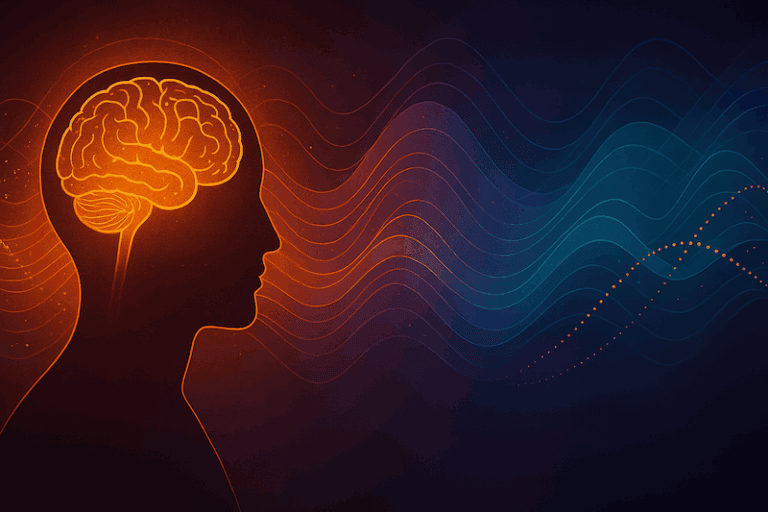
In neuroscience, emotional states correspond to distinct patterns of brain activity. Brainwaves — oscillations measured in frequency — shift depending on stress, calm, fear, focus, or safety. In neurofeedback, these oscillations are made visible to the nervous system, allowing it to recognize its own patterns and gradually reorganize toward coherence.
Cymatics makes this same process visible in matter itself. When sound moves through water, frequency becomes form. Change the frequency, and the pattern reorganizes. Coherent input creates symmetry. Disrupted input produces fragmentation.
This is not metaphorical.
The human body is composed largely of water. Every organ functions within a fluid environment, constantly responding to vibration — from neural firing, from the heartbeat, from breath, and from sound.
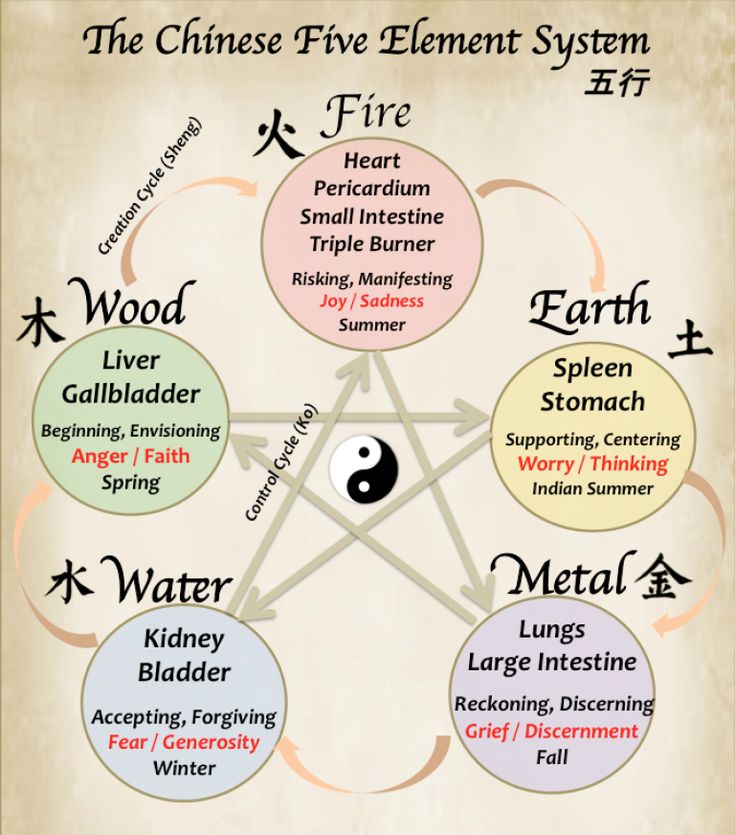
Traditional Chinese medicine describes this self-organizing process through the Five Elements, mapping emotional patterns to organ systems and modes of movement. Different language, same logic: when flow is harmonious, the system adapts; when flow is constrained or excessive, symptoms appear.
This interplay between frequency, emotion, and physiology is what we call the Emotion Creation Cycle.
Let’s start with the Fire — Heart & Small Intestine
Fire governs rhythm, circulation, and emotional brightness. It lives in the heart and small intestine, organs intimately tied to timing, discernment, and connection.
From a neuroscientific perspective, heightened emotional arousal is reflected in accelerated neural rhythms and autonomic activation. From a cymatic perspective, excessive intensity disrupts pattern coherence.
When Fire is balanced, joy emerges naturally.
When Fire becomes excessive, emotional heat accumulates — anger, impatience, cruelty, hate — often accompanied by palpitations, elevated blood pressure, or chest pain.
Sound introduces a regulatory frequency.
With one hand on the chest, the exhale is shaped into:
Hooooow…
The long exhalation slows neural firing, softens cardiac rhythm, and — as cymatics would predict — restores coherence through frequency.
Earth — Stomach, Spleen & Pancreas
Earth governs digestion, integration, and emotional stability.
Neuroscience describes this through the gut–brain axis, where emotional stress alters neural signaling to the digestive system. Cymatics shows us that overloaded frequencies destabilize structure.
When Earth is balanced, we feel grounded, fair, open, and trusting.
When Earth is strained, emotion loops — worry, anxiety, overthinking, mistrust — often accompanied by impaired digestion, constipation, or abdominal discomfort.
With one hand placed just below the rib cage, attention returns to an interoceptive center — a site where emotional awareness and visceral sensation meet.
On the exhale:
Whooooo…
Frequency slows. The abdomen softens. The system regains its capacity to digest — emotionally and physically.
Metal — Lungs & Large Intestine
Metal governs breath, boundaries, and release.
In neuroscience, grief alters respiratory rhythm and vagal tone. In cymatics, incomplete release leaves patterns dense and constricted.
When Metal is balanced, there is clarity and quiet strength.
When burdened, sadness accumulates, breath becomes shallow, elimination slows.
The sound of release is:
Sssssss…
A sustained exhale that lengthens breath, reduces neural tension, and allows the pattern to loosen.
Water — Kidneys & Bladder
Water governs depth, vitality, and the nervous system’s response to fear.
Fear is reflected neurologically in heightened vigilance and survival circuitry. Cymatically, abrupt frequencies fragment the field.
When Water is balanced, calmness and stillness emerge.
When disturbed, fatigue and nervous tension follow.
With one hand on the lower abdomen or back:
Choooo…
The sound slows the system, conserving energy and restoring depth.
Wood — Liver & Gallbladder
Wood governs movement, direction, and emotional flexibility.
Blocked movement — whether neural, emotional, or physical — produces tension. Cymatics shows us that stagnation distorts symmetry.
When Wood flows, there is clarity and vision.
When blocked, frustration, resentment, and suppressed anger accumulate, often expressed as rib tension, jaw tightness, headaches, and irritability.
The sound that restores flow is:
Shhhhh…
Slow, continuous, smoothing.
As in cymatics, movement restores order.
Conclusion
Neuroscience measures it. – Cymatics makes it visible. – Chinese medicine maps it.
The body organizes itself through frequency.
Emotions are not merely felt — they are patterned, distributed, and regulated through rhythm. When breath and sound introduce coherent frequency, the system responds, not through force, but through recognition.
Healing, in this sense, is resonance. Healing is presence, awareness!
One frequency at a time. One organ at a time. One returning rhythm.


 Română
  English